The Illusion of Conversation
When you chat with an AI assistant like ChatGPT or Claude, the experience feels remarkably human. The assistant remembers what you said earlier, responds in natural language, and seems to understand your intent. It is easy to imagine that there is something like a mind behind the interface — a digital consciousness reading your messages and formulating thoughtful replies. But the reality beneath the surface is quite different.
An AI chatbot isn't a conscious entity thinking about your questions. It is an extremely sophisticated text prediction engine — a large language model that generates responses by predicting, one token at a time, the most likely continuation of the conversation. When you send a message, the entire conversation history — including system instructions, your previous messages, and the assistant's previous responses — is formatted into a single text sequence. The model processes this sequence and generates a response by repeatedly predicting the next token.
Here's the thing: this process is fundamentally different from human conversation. When a human responds to a question, they think about the answer, retrieve relevant knowledge, consider the listener's perspective, formulate a response, and then speak. An AI chatbot does none of these things in the human sense. It has no thoughts, no beliefs, no understanding. It has only a vast statistical model of language patterns, enabling it to produce text that matches the patterns it learned during training. The conversation you experience is an illusion created by the sophistication of these patterns.
The Architecture of a Chatbot System
A modern AI chatbot iisn'ta single model but a system of multiple components working together. The foundation is the large language model — the core text generation engine. This model is typically a Transformer-based neural network with billions of parameters. It is the component that actually generates the response text. But the model alone does not make a complete chatbot.
The system prompt is a crucial component that sets the behavior of the chatbot. This is a specially crafted instruction that's prepended to every conversation, invisible to the user. It defines the chatbot's persona, capabilities, limitations, and behavioral guidelines. The system prompt for a helpful assistant might include instructions like "You are a helpful, harmless, and honest AI assistant" along with specific rules about refusing harmful requests, admitting uncertainty, and following user instructions. The model's responses are shaped entirely by how this system prompt interacts with the user's messages.
Let me give you a concrete example. Safety filters and content moderation systems run in parallel with the core model. These systems analyze both user inputs and model outputs for harmful content — hate speech, instructions for illegal activities, dangerous information, and other prohibited categories. If the input or output triggers a safety rule, the system may block the response, return a default refusal message, or flag the interaction for review. This layered safety architecture is essential for deploying AI chatbots in public-facing applications.
Some chatbot implementations use Retrieval-Augmented Generation (RAG) to improve accuracy. Before the model generates a response, the RAG system searches an external knowledge base for relevant information and injects it into the context. This allows the chatbot to access up-to-date information, specific documents, or proprietary knowledge that was not part of its training data. RAG is increasingly used in enterprise chatbots to provide accurate information about company policies, products, and procedures.

How Context and Memory Work
One of the most impressive capabilities of modern AI chatbots is their ability to maintain context across extended conversations. When you refer back to something you said ten messages ago, the assistant seems to remember it. This context maintenance is achieved through a simple but powerful mechanism: the entire conversation history is included in every request.
A friend asked me about this recently, and each time you send a message, the chatbot system constructs a prompt that includes the system instructions, the full conversation history, and your latest message. This entire text is fed into the language model, which processes it all at once. The model's attention mechanism can relate your current message to any earlier part of the conversation, creating the impression of memory. But this is not memory in the human sense — it is just more text that the model conditions its predictions on.
This approach has important limitations. The total amount of text the model can process at once is bounded by its context window — typically between 4,000 and 200,000 tokens for current models. Once the conversation exceeds this limit, older messages must be dropped or summarized. This is why very long conversations may lose early context or degrade in quality. Some systems implement summarization strategies where old conversation segments are condensed into shorter summaries to preserve key information within the context window.
The model has no persistent memory beyond the current conversation. When you start a new conversation, the chatbot has no recollection of previous conversations. It doesn't learn or remember anything from one chat session to the next, unless the system is specifically designed with external memory mechanisms. Every conversation starts from a blank slate, shaped only by the system prompt and the current exchange.
The Response Generation Process
When the chatbot processes your message, it goes through a specific sequence of operations to generate a response. The process begins with tokenization: your input text is converted into tokens, the numerical representations the model works with. Each token is mapped to an ID in the model's vocabulary, and the sequence of IDs becomes the input to the neural network.
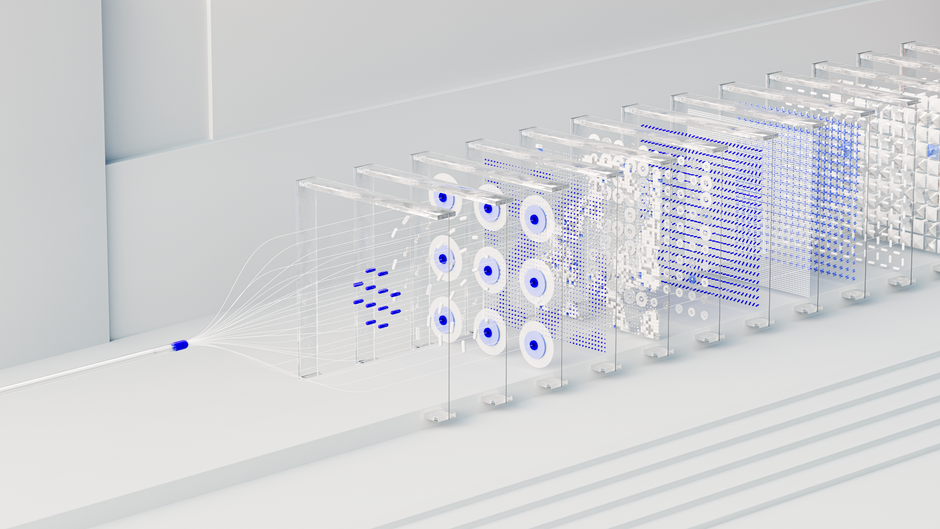
The tokens then pass through the model's transformer layers. At each layer, the attention mechanism lets every token "look at" every other token, building a rich contextual representation. The model computes how strongly each token relates to every other token, allowing it to understand the relationships between words, resolve ambiguities, and track references across the conversation. This is the most computationally intensive part of the process.
After passing through all the transformer layers, the final layer produces a probability distribution over every possible next token. For example, after processing "The capital of France is," the model might assign a 95 percent probability to "Paris," 2 percent to "Lyon," 0.5 percent to "France," and tiny probabilities to every other token in its vocabulary. The model then samples from this distribution to select the next token.
The sampling process introduces controlled randomness. Instead of always picking the most likely token — which would produce repetitive, dull text — the model samples according to the probability distribution. A parameter called temperature controls how much randomness is introduced. Low temperature (near 0) makes the output focused and deterministic. High temperature (near 1 or above) makes it more creative and varied. After each token is generated, it is appended to the sequence, and the process repeats until the model generates a stop token or reaches the maximum response length.
Why Chatbots Sometimes Get Things Wrong
From what I've seen, understanding how chatbots generate responses explains several common failure modes. Since the model is predicting the most likely text based on patterns, not retrieving verified facts, it can confidently produce incorrect information — the hallucination problem discussed earlier. The model has no internal fact-checker, no connection to external databases, and no ability to verify its own outputs against reality.
The model's training data cutoff date means it cannot know about events that occurred after training. If you ask about breaking news, the model either draws on its general knowledge about similar situations or — if it was fine-tuned to say so — admits it does not have that information. Some chatbots augment their capabilities with web search or RAG to overcome this limitation.
The model can also be inconsistent across conversations. The same prompt might produce different responses due to the randomness in the sampling process. The model does not have stable beliefs or opinions — it generates text based on statistical patterns, not convictions. Understanding these limitations is essential for using chatbots effectively.
For a deeper understanding of the models that power chatbots, read our guide on understanding large language models and explore AI hallucinations.
So, Should You Try It?
- AI chatbots are text prediction engines, not conscious entities — they generate responses one token at a time
- The system prompt, safety filters, and core language model work together to produce safe, helpful responses
- Context and memory are achieved by including the full conversation history in every request — took me a while to figure this out
- Response generation involves tokenization, transformer processing, probability calculation, and controlled random sampling
- The temperature parameter controls the randomness and creativity of responses — wish I'd known this six months ago
- Chatbots have no persistent memory across conversations and are limited by their context window and training data — your experience may differ, but this worked for me
- Understanding the underlying mechanisms helps set appropriate expectations for chatbot capabilities and limitations — took me a while to figure this out