The Hierarchy of Intelligence Technologies
Not even close.
Artificial intelligence, machine learning, and deep learning are three of the most used — and most confused — terms in technology today. They are often used interchangeably in news articles and marketing materials, but they refer to distinct concepts with specific meanings. Understanding the relationships between them is essential for anyone who wants to navigate the AI landscape with confidence.
Think of these technologies as a set of nested Russian dolls. Artificial intelligence is the largest, most encompassing doll. It represents the entire field of creating intelligent machines — any technology that enables computers to perform tasks that would normally require human intelligence. Machine learning is a smaller doll inside AI — a specific approach to achieving AI through data-driven learning rather than explicit programming. Deep learning is the smallest doll inside machine learning — a particular technique that uses multi-layered neural networks to learn from data.
Here's a real example from my own use: this nesting relationship means that all deep learning is machine learning, but not all machine learning is deep learning. And all machine learning is AI, but not all AI involves machine learning. The boundaries between these categories can blur in practice, but understanding the hierarchy provides a useful framework for thinking about different AI technologies and their appropriate applications.
But does it actually work that way?
Artificial Intelligence: The Broadest Category
Game changer.
Artificial intelligence is the grandparent category, encompassing any technique that enables machines to mimic human intelligence. This includes everything from simple rule-based systems to the most sophisticated deep neural networks. The defining characteristic of AI is that the machine performs tasks that, when done by humans, require intelligence. Under this broad definition, many technologies qualify as AI that might not match the popular image of intelligent machines.
A friend asked me about this recently, and rule-based systems, also called expert systems, are a classic form of AI that doesn't involve machine learning. A medical diagnosis expert system might contain thousands of if-then rules encoded by human doctors: IF the patient has symptom A AND symptom B, THEN consider diagnosis C with weight 0.8. These systems were the dominant form of AI in the 1980s and achieved significant commercial success. They're transparent — you can trace exactly why they reached a particular conclusion — but they are brittle and require enormous effort to build and maintain.
Symbolic AI, also known as Good Old-Fashioned AI (GOFAI), represents knowledge through symbols and logical rules. It dominated AI research from the 1950s through the 1980s. Symbolic approaches excel at problems that can be formalized logically — theorem proving, game playing with complete information, planning — but struggle with perception, language, and pattern recognition. The limitations of symbolic AI motivated the shift toward machine learning approaches that could learn from data rather than requiring hand-coded knowledge.
The term "AI" in popular usage has narrowed over time. When people talk about AI today, they usually mean machine learning, and often specifically deep learning. But it's important to remember that AI is a vast field with many approaches, and what we call AI will likely continue to evolve as the technology advances.
Machine Learning: Learning from Data
After testing this extensively, machine learning is a subset of AI that focuses on systems that learn from data rather than following explicitly programmed rules. Instead of a programmer writing instructions for every possible situation, the system discovers patterns in data and uses those patterns to make predictions or decisions. This approach has proven far more effective than rule-based systems for problems involving perception, language, and complex pattern recognition.
Traditional machine learning includes a diverse family of techniques. Decision trees learn a series of if-then decisions from data, producing interpretable models that work well for many business applications. Support vector machines find optimal boundaries between categories, performing well on classification tasks with clear margins. Random forests combine many decision trees to improve accuracy and reduce overfitting. Logistic regression, despite its name, is a classification technique widely used for tasks like credit scoring and click-through rate prediction.
Machine learning requires feature engineering — the process of selecting and constructing the input variables that the model uses. A machine learning system predicting housing prices might use features like square footage, number of bedrooms, location, and year built. The quality of these features significantly impacts model performance. Feature engineering requires domain expertise and is often the most time-consuming part of building a traditional ML system. This is one of the key differences between traditional ML and deep learning.
Let me give you a concrete example. Machine learning also encompasses different learning paradigms. Supervised learning requires labeled data — inputs paired with correct outputs. Unsupervised learning finds patterns in unlabeled data. Reinforcement learning learns through trial and error interaction with an environment. Semi-supervised learning combines a small amount of labeled data with a large amount of unlabeled data. Each paradigm suits different types of problems and data availability.
Deep Learning: Neural Networks at Scale
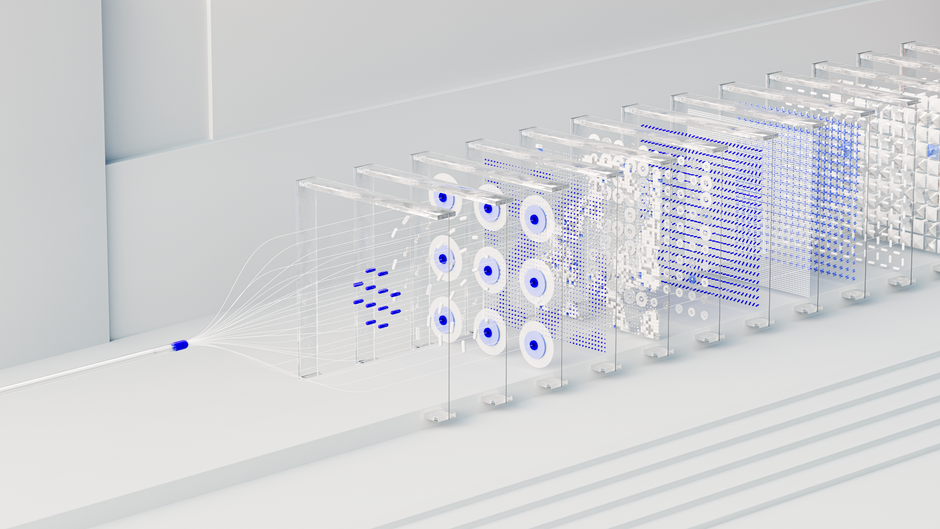
Deep learning is a subset of machine learning that uses artificial neural networks with multiple layers — hence the term "deep." These networks are loosely inspired by the structure of the biological brain, with layers of interconnected artificial neurons that process information hierarchically. What distinguishes deep learning from traditional machine learning is its ability to automatically learn feature representations from raw data.
The key advantage of deep learning is that it eliminates the need for manual feature engineering. A deep learning model for image recognition learns its own features at multiple levels of abstraction. Low layers learn simple patterns like edges and colors. Middle layers learn shapes and textures. High layers learn complete objects and concepts. This hierarchical learning allows deep learning models to achieve superior performance on complex tasks involving unstructured data — images, audio, text, and video.
Deep learning requires substantially more data and compute than traditional machine learning. A deep neural network for image classification might need millions of labeled images and days of training on specialized hardware. A traditional machine learning approach might achieve acceptable results with thousands of examples and a standard laptop. This trade-off — higher resource requirements for better performance on complex tasks — determines when to use deep learning versus simpler approaches.
The major deep learning architectures include Convolutional Neural Networks (CNNs) for images, Recurrent Neural Networks (RNNs) and Transformers for sequences and text, and Generative Adversarial Networks (GANs) and diffusion models for content generation. Each architecture is designed to exploit the structure of its target data type, incorporating inductive biases that make learning more efficient.
So what does this mean in practice?
When to Use Which Approach
Here's why.
Choosing between AI approaches depends on the problem, available data, and constraints. Traditional machine learning remains the best choice for many business applications. If you've structured data in a spreadsheet, need interpretable predictions for regulatory compliance, and have moderate amounts of data, a decision tree or logistic regression model may be the best tool. These models are simpler to train, easier to deploy, and more transparent than deep learning alternatives.
Deep learning excels when data is abundant and the problem involves unstructured data like images, audio, or text. If you need to classify images, understand natural language, or generate content, deep learning is almost certainly the right approach. The improved performance of deep learning on these tasks justifies its higher computational cost. For problems with very large datasets, deep learning often achieves results that traditional ML can't match.
I'll be honest: rule-based and symbolic AI approaches remain valuable for problems that can be precisely specified. If you need a system that must never make certain errors, or if you need complete explainability for regulatory reasons, rule-based approaches may still be the best choice. Many practical AI systems combine multiple approaches — using rules for well-understood cases and machine learning for complex pattern recognition.
For a deeper dive into the foundational technology of deep learning, read our exploration of how neural networks work. You can also learn about understanding AI parameters and tokens for a more technical perspective on modern AI.
What's the catch?
So, Should You Try It?
I've been using this for a while now, and - AI is the broadest field, encompassing any technology that enables machines to perform intelligent tasks
- Machine learning is a subset of AI focused on systems that learn patterns from data — wish I'd known this six months ago
- Deep learning is a subset of machine learning using multi-layered neural networks for automatic feature learning — game changer in my workflow
- Traditional machine learning requires manual feature engineering; deep learning learns features automatically
- Traditional ML works well with structured data and smaller datasets; deep learning excels with unstructured data at scale
- Rule-based and symbolic AI approaches remain valuable for problems requiring transparency and precise control — game changer in my workflow
- The best approach depends on the specific problem, available data, interpretability requirements, and computational resources