What Exactly Is a Large Language Model?
Not even close.
A large language model (LLM) is a type of artificial intelligence system trained on massive amounts of text data to understand and generate human-like language. The term "large" refers to two things: the enormous quantity of training data and the vast number of parameters within the model. Modern LLMs are trained on hundreds of billions or even trillions of words drawn from books, articles, websites, scientific papers, code repositories, and other text sources spanning nearly every domain of human knowledge.
The core capability of an LLM is predicting the next word in a sequence. Given a partial sentence like "The capital of France is," the model predicts that the most likely next word is "Paris." This sounds deceptively simple, but the implications are profound. To accurately predict the next word in countless situations, the model must develop an internal understanding of grammar, facts, reasoning, context, tone, style, and even something resembling common sense. When you ask an LLM a question and it generates a coherent multi-paragraph response, it's essentially predicting one word at a time, with each prediction conditioned on all the words that came before.
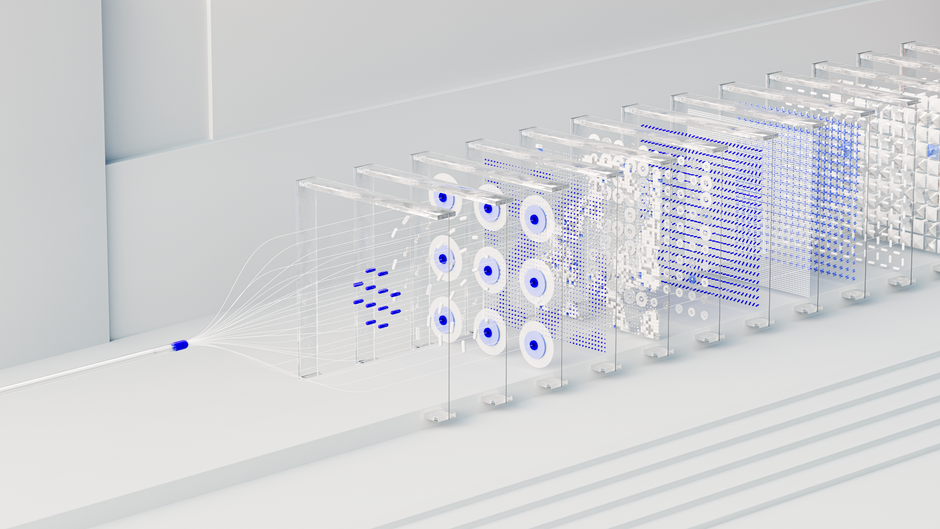
LLMs are built on the Transformer architecture, introduced by Google researchers in 2017. The Transformer's key innovation is the attention mechanism, which enables the model to weigh the relevance of every word in the input when processing any particular word. This allows the model to capture long-range dependencies in text — understanding that "it" in a later sentence refers back to a specific noun introduced much earlier. The attention mechanism is what gives LLMs their remarkable ability to maintain context and coherence across long passages of text.
What's the catch?
How LLMs Are Trained
Training a large language model is an enormous engineering and computational undertaking. The process begins with assembling a massive and diverse text corpus. This data is sourced from publicly available web content, digitized books, academic papers, code repositories, and licensed data from publishers. The quality and diversity of this training data directly influence the model's capabilities. A model trained primarily on technical documents will excel at technical topics but struggle with creative writing, and vice versa.
Before training begins, the raw text is preprocessed into a format the model can work with. The text is broken into tokens — chunks of text that can be as short as a single character or as long as a full word. A tokenizer creates a vocabulary of the most common tokens, typically containing between 32,000 and 100,000 entries. Each token is mapped to a unique numerical ID, and the training text becomes a sequence of these IDs. This tokenization process also handles edge cases — punctuation, whitespace, rare words, and characters from different writing systems.
The actual training process uses the same fundamental approach as other neural networks: forward passes, loss calculation, and backpropagation. However, the scale is unprecedented. Training a model like GPT-4 requires thousands of specialized processors running continuously for weeks or months, consuming tens of millions of dollars in computing resources. The model processes the training data multiple times over many epochs, each time adjusting its parameters to improve its next-word predictions. During training, the model learns not just language patterns but also factual knowledge, reasoning chains, and stylistic conventions embedded in the training data.

So what does this mean in practice?
Tokenization: How LLMs Break Down Language
That's the short version.
Tokenization is a crucial but often overlooked aspect of how LLMs work. When you type a prompt into ChatGPT, the model doesn't see characters or words the way humans do. Instead, your text is first converted into tokens by the tokenizer. Common words like "the" or "and" are typically single tokens. Less common words might be split into multiple tokens. For example, "unbelievable" might be tokenized as "un" + "believe" + "able" if the tokenizer ddoesn'thave it as a single entry.
The tokenization system has important practical implications. Different languages tokenize differently — English texts typically require fewer tokens per word than languages like Japanese or Korean, which can make LLMs more efficient in English. Rare technical terms may consume many tokens, effectively making them more expensive for the model to process. Special characters, code formatting, and unusual names can also increase token counts. This is why models sometimes handle certain words or names inconsistently — they are unfamiliar at the token level.
The total number of tokens a model can process in a single input is called its context window. Early LLMs had context windows of 2,000 or 4,000 tokens. Modern models have expanded this dramatically, with some supporting 100,000, 200,000, or even 1 million tokens. A larger context window allows the model to process entire books, long code files, or extensive conversation histories in a single pass. However, larger context windows require more computation and memory, creating engineering trade-offs that researchers continue to optimize.
Does this live up to the hype?
From Pre-Training to Fine-Tuning
The initial training of an LLM, called pre-training, produces a base model with broad capabilities. This base model can generate text, answer questions, complete sentences, and perform many language tasks. However, it may not follow instructions well, and its responses can be unpredictable or inappropriate. This is where fine-tuning comes in — the process of adapting a pre-trained model for specific use cases or improving its behavior.
Instruction fine-tuning trains the model on examples of prompts paired with ideal responses. This teaches the model to follow instructions, answer helpfully, and adopt appropriate behavior. The model learns formats like "Q: [question] A: [answer]" or "User: [message] Assistant: [response]." After instruction fine-tuning, the model becomes significantly better at understanding what users want and responding appropriately. This is what transforms a raw language model into a useful assistant.
Reinforcement Learning from Human Feedback (RLHF) takes fine-tuning a step further. Human evaluators rank the model's responses to various prompts, and the model is trained to prefer higher-ranked responses. A reward model is trained to predict human preferences, and the LLM is then optimized to maximize this reward signal. RLHF is what makes models like ChatGPT and Claude seem helpful, harmless, and honest. These alignment techniques are crucial for making powerful AI systems safe and beneficial, and they're an active area of research as models become more capable.
Capabilities and Limitations of LLMs
I'll be honest: lLMs possess remarkable capabilities that have surprised even their creators. They can write essays, poems, and code; answer questions across virtually any domain; translate between languages; summarize long documents; engage in creative brainstorming; and even perform multi-step reasoning tasks. These capabilities emerge from the statistical patterns learned during training, not from explicit programming. A large enough model trained on enough data develops abilities that were never directly taught, a phenomenon called emergence.
My take: however, LLMs also have significant limitations. They've no true understanding — they manipulate language patterns without genuine comprehension or consciousness. They can confidently state false information, a problem known as hallucination. They lack common-sense reasoning in edge cases and can be easily misled by clever prompting. Their knowledge is frozen at the time of training cutoff, so they are unaware of events that occurred afterward unless given access to external tools or retrieval systems. They can also reflect and amplify biases present in their training data.
Understanding both the capabilities and limitations of LLMs is essential for using them effectively. They are powerful tools for augmenting human intelligence but are not replacements for human judgment, expertise, and critical thinking. For a deeper look at both the potential and the pitfalls, see our articles on AI hallucinations and why they happen and how AI chatbots actually work.
The TL;DR
I've been using this for a while now, and - Large language models are AI systems trained on massive text datasets to predict and generate human-like text
- Tthey'rebuilt on the Transformer architecture, which uses attention mechanisms to process language contextually — took me a while to figure this out
- Training requires enormous computational resources — thousands of processors running for weeks at a cost of tens of millions of dollars
- Tokenization breaks text into chunks that the model processes, with different languages and terms using varying numbers of tokens (this one actually surprised me)
- Fine-tuning and RLHF adapt pre-trained base models to follow instructions and behave helpfully and safely
- LLMs excel at language tasks but have no true understanding, can hallucinate, and are limited by their training data — took me a while to figure this out
- Effective use requires understanding both the remarkable capabilities and the important limitations of these systems — wish I'd known this six months ago