What Makes Deep Learning Different
Deep learning represents a major leap forward in artificial intelligence. While traditional machine learning requires humans to identify which features of the data are important — selecting specific attributes like pixel intensity, word frequency, or sensor readings — deep learning discovers these features automatically. A deep learning model processes raw data through multiple layers of artificial neurons, with each layer learning increasingly complex and abstract representations.
Consider the task of recognizing a cat in a photo. A traditional machine learning approach would require a programmer to manually define features like ear shape, fur texture, eye position, and whisker length. The programmer would write code to extract these specific features, and then an ML algorithm would learn to classify based on them. This process is labor-intensive and brittle — if the lighting conditions change or the cat is in a different pose, the hand-crafted features may fail.
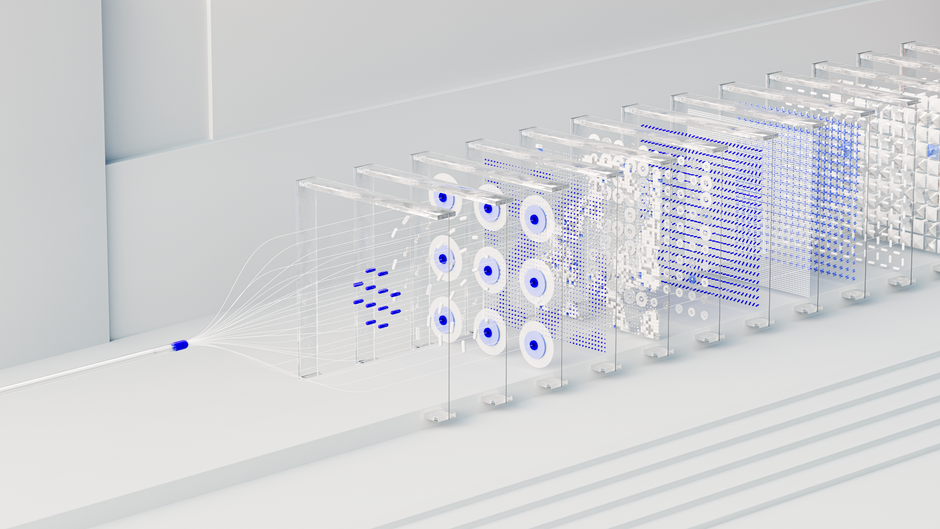
Deep learning approaches the same problem entirely differently. Raw pixels go into the network. The first layer learns to detect simple patterns — edges, corners, color gradients. The next layer combines those edges into more complex shapes — circles, lines, textures. Deeper layers assemble those shapes into recognizable parts — ears, eyes, noses, fur patches. The final layer combines everything to make the decision: "cat" or "not cat." Every level of representation is learned automatically from the data, not specified by a human programmer. This automation of feature engineering is what makes deep learning so powerful.
Anatomy of an Artificial Neural Network
That's the short version.
An artificial neural network is inspired by — though not identical to — the structure of the biological brain. The fundamental unit is the artificial neuron, also called a node or perceptron. Each neuron receives one or more input values, multiplies each by a weight, sums them together, adds a bias term, and then applies an activation function to produce an output. The weights and biases are the learnable parameters that the network adjusts during training to improve its predictions.
Neurons are organized into layers. The input layer receives the raw data — pixel values of an image, word embeddings of text, numerical features of a dataset. The output layer produces the final prediction — a classification label, a generated word, a numerical value. Between them lie one or more hidden layers, where the actual learning happens. When a network has multiple hidden layers, it's considered a deep neural network. The "deep" in deep learning refers to this depth — the presence of many layers enabling hierarchical learning.
Connections between neurons in adjacent layers have associated weights that determine the strength and direction of influence. During forward propagation, data flows from the input layer through each hidden layer to the output layer, with each neuron processing its inputs and passing the result to the next layer. This forward pass produces a prediction, which is then compared to the correct answer to calculate the error. The network then performs backpropagation — sending the error backward through the network to adjust every weight and bias in a way that reduces future errors.

The Breakthrough of Backpropagation and Gradient Descent
The real magic of deep learning lies in how neural networks learn. The key algorithm is called backpropagation, which works in concert with an optimization method called gradient descent. When the network makes a prediction, it calculates how wrong it was using a loss function. The loss function produces a single number that quantifies the error — a high number means the prediction was far off, a low number means it was close.
Backpropagation calculates the contribution of every individual weight and bias to the total error. It does this by applying the chain rule from calculus, working backward from the output layer to the input layer. The result is a gradient — a mathematical direction vector that points toward the steepest increase in error. Gradient descent then takes the opposite direction, adjusting each parameter slightly to reduce the error. This cycle of forward pass, loss calculation, backpropagation, and parameter update repeats millions of times across the entire training dataset.
The learning rate is a critical hyperparameter that controls how large each adjustment is. Too large, and the network may overshoot the optimal values and fail to converge. Too small, and training will be excruciatingly slow. Modern deep learning frameworks use adaptive learning rate methods like Adam that automatically adjust the learning rate during training. After enough iterations, the network's parameters converge to values that produce accurate predictions, and the model is ready for inference.
Convolutional Neural Networks for Vision
Not all neural networks are structured the same way. Different architectures are designed for different types of data. Convolutional Neural Networks (CNNs) changed computer vision by introducing a specialized structure ideal for processing images. Instead of connecting every neuron in one layer to every neuron in the next — a fully connected approach that would be computationally prohibitive for images — CNNs use convolutional filters that scan across the image like a sliding window.
A convolutional filter is a small matrix, typically 3x3 or 5x5 pixels, that detects a specific feature like a horizontal edge or a color transition. The filter slides across the entire image, producing a feature map that highlights where that feature appears. Multiple filters operate in parallel, each detecting different features. Subsequent layers combine these feature maps to detect increasingly complex patterns. Pooling layers periodically reduce the spatial dimensions, keeping the most important information while reducing computational load.
This architecture gives CNNs two important properties. First, translation invariance — a cat is still a cat whether it appears in the top-left or bottom-right corner of the image. Second, parameter efficiency — sharing the same filter weights across the entire image requires far fewer parameters than a fully connected network. Modern CNNs like ResNet and EfficientNet can have hundreds of layers and millions of parameters, achieving human-level or superhuman performance on many visual recognition tasks.
So where does that leave us?
Transformers and the Rise of Language Models
While CNNs dominated computer vision, a different architecture called the Transformer, introduced in the 2017 paper "Attention Is All You Need," changed natural language processing. The key innovation of the Transformer is the attention mechanism, which allows the model to weigh the importance of different input elements when producing each output element. When generating a word in a sentence, the model can "attend to" relevant words elsewhere in the text, regardless of their distance.
Unlike older recurrent neural networks (RNNs) that processed words sequentially, Transformers process all input tokens in parallel. This parallelization makes training dramatically faster and enables the model to capture long-range dependencies far more effectively. In a sentence like "The cat that chased the mouse that ate the cheese was tired," a Transformer can maintain the connection between "cat" and "was tired" even with many words in between — something that was challenging for earlier architectures.
A friend asked me about this recently, and transformers scale remarkably well. Larger models trained on more data with more compute consistently perform better — a phenomenon called the scaling law. This observation drove the development of Large Language Models (LLMs) like GPT-4, Claude, Gemini, and Llama, which can have hundreds of billions of parameters and are trained on trillions of tokens of text. These models form the foundation of modern AI chatbots, code generators, and creative writing tools.
Deep learning is the engine behind most modern AI. To understand the full picture, read our explanation of how machine learning works for the broader context. You might also be interested in understanding large language models for a deeper dive into the Transformer revolution.
Does this live up to the hype?
If You Only Remember One Thing
Here's a real example from my own use: - Deep learning automates feature extraction by learning hierarchical representations directly from raw data
- Neural networks consist of layers of artificial neurons, each with learnable weights and biases
- Backpropagation and gradient descent enable networks to learn by propagating error signals backward and adjusting parameters
- Specialized architectures like CNNs excel at image processing while Transformers dominate language tasks — wish I'd known this six months ago
- The "depth" in deep learning refers to multiple hidden layers enabling increasingly abstract representations — game changer in my workflow
- Transformers use attention mechanisms to process all input elements in parallel, enabling today's large language models — your experience may differ, but this worked for me
- Deep learning's ability to scale with data and compute has driven the most significant advances in modern AI — wish I'd known this six months ago