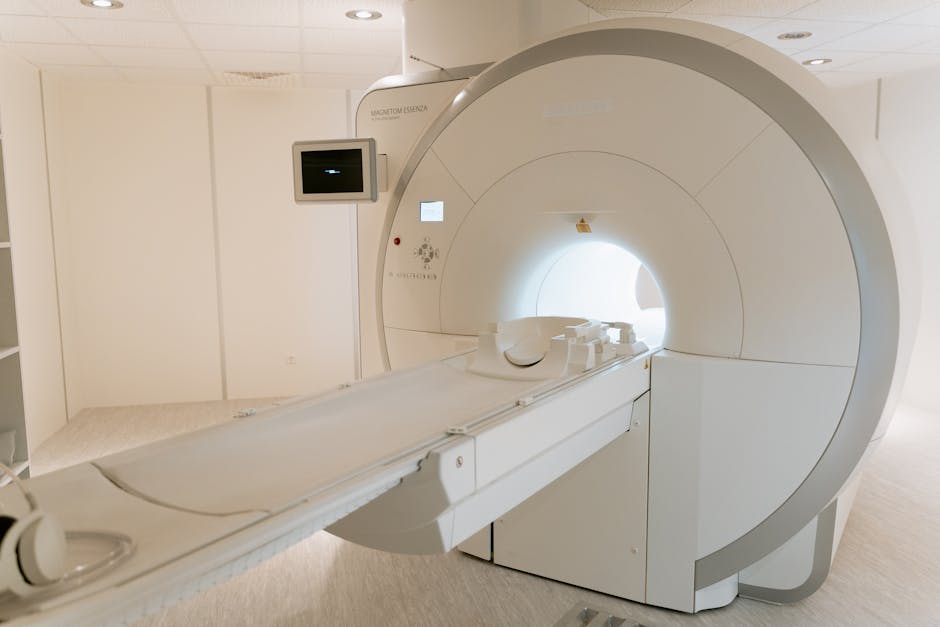
The Weirdest Announcement I've Seen All Year
Last week, Midjourney—yes, that Midjourney, the company whose AI image generator has been making artists nervous and memes ubiquitous—dropped a press release that made me do a double take. They're pivoting to medical imaging. Specifically, a futuristic ultrasound scanner that dunks you into a vat of water and, according to the company's own breathless language, promises to produce "something as powerful as MRI" yet "as casual as a trip to the spa."
I read that sentence three times. I checked the date. It's not April Fools'. This is real.
Let me be clear: I love weird tech. I've spent years covering everything from smart toasters to brain-computer interfaces. But this announcement feels less like innovation and more like a fever dream written by someone who just watched The Fly and thought, "You know what, let's add some AI to that."
According to www.theverge.com's detailed report on the announcement, the device—which the company is calling "Midjourney MedScan" for now—would use a combination of ultrasound transducers and proprietary AI algorithms to create detailed internal images. The patient sits in a water-filled chamber, and the scanner rotates around them. It sounds vaguely like a CT scanner designed by Apple. But here's the kicker: there's no peer-reviewed research, no clinical trials, and no evidence that any of this actually works.
What Midjourney Is Actually Promising
Midjourney's CEO David Holz—who I've interviewed before about the ethics of AI art—gave a presentation that was heavy on vision and light on details. He talked about "democratizing medical imaging" and making it "accessible to everyone." He showed concept renders that look like something out of Star Trek: The Next Generation. Sleek white chambers. Glowing blue water. A user interface that's all smooth gradients and soft edges.
Absent from the presentation: any actual medical data. Any radiologists nodding in approval. Any mention of FDA approval, which, by the way, is a multi-year process for new imaging devices. The company claims they'll start "beta testing" in spas and wellness centers by early 2027. Spas. Not hospitals. Not clinics. Spas.
I called up a friend who's a radiologist at a major teaching hospital. She laughed. Then she got quiet. "This is dangerous," she told me. "People might skip actual medical scans for this spa thing. They might get false reassurance or, worse, false alarms."
The Missing Evidence Problem
Here's the thing about medical imaging: it's hard. Really hard. Ultrasound, MRI, CT—these technologies have been refined over decades, with countless studies validating their accuracy, sensitivity, and safety. A single new imaging technique requires years of clinical validation before it can be trusted for diagnosis.
Midjourney's website for the MedScan includes a page titled "The Science" that, when I checked it, contained exactly two paragraphs of vague language about "neural networks trained on millions of images" and "proprietary signal processing." No links to papers. No preprints. No data sets released for independent verification.
According to www.theverge.com, the company hasn't published any technical specifications for the ultrasound array, the water temperature management system, or the AI model's performance metrics. When asked for comment, a Midjourney spokesperson told the publication that "more details will be shared in the coming months." That's PR-speak for "we don't have them yet."
I've seen this pattern before. A tech company with a flashy demo and no substance announces a "revolutionary" medical device. Theranos did it. More recently, various AI-powered diagnostic tools have made big promises and then quietly folded when regulators came knocking. Midjourney's pivot feels eerily similar.
The Spa Angle Is Deeply Concerning
Let's talk about that "as casual as a trip to the spa" framing. Because honestly, that's the most troubling part of this whole thing.
Medical imaging is not a spa treatment. It's a medical procedure. It involves radiation exposure (in the case of CT and X-ray), strong magnetic fields (MRI), or sound waves (ultrasound). It requires trained technicians who know how to position patients, interpret artifacts, and recognize when something looks wrong. The idea that you can just hop into a water tank, let an AI do its thing, and walk out with a diagnosis is not just wrong—it's dangerous.
Midjourney seems to be targeting the wellness crowd: people who already spend money on cryotherapy, float tanks, and infrared saunas. The pitch is seductive: get a full-body scan while you relax, no doctor's appointment needed. But what happens when the AI finds something? Who tells you? What follow-up do you get? The company hasn't answered these questions.
I spoke to a bioethicist at Stanford who told me, off the record, that she's worried about "diagnostic tourism"—people seeking out these spa scanners instead of proper medical care. "It's the wellness industry co-opting real medicine," she said. "And it's going to hurt people."
The Midjourney Brand Problem
Midjourney's core product is an AI image generator that's beloved by designers, artists, and meme-makers. It's a creative tool. It's not a medical device company. The company has no experience with regulatory approval, clinical trials, or patient safety. Its team is made up of engineers and designers, not doctors or medical device experts.
According to LinkedIn (I checked), Midjourney currently has zero listed employees with medical degrees. Zero. The company's chief technology officer has a background in computer graphics. The lead designer worked on video games. This is not a knock on their skills—I've used Midjourney's image generator and it's genuinely impressive. But medical imaging is a different beast entirely.
Imagine Apple suddenly announcing they're building a nuclear reactor. Or OpenAI launching a restaurant chain. That's the level of pivot we're talking about here. It makes no sense from a product, regulatory, or trust perspective.
The Regulatory Black Hole
Medical devices in the United States are regulated by the FDA. The process for a new imaging device involves multiple phases of clinical trials, safety testing, and quality system audits. It typically takes three to seven years and costs tens of millions of dollars. And that's for devices that have a clear path to approval.
Midjourney hasn't submitted anything to the FDA. They haven't even announced plans to. Their timeline—beta testing in spas in early 2027—suggests they're trying to operate outside the traditional medical framework. Spas are not regulated like hospitals. They can install pretty much any device they want, as long as it doesn't make specific medical claims.
But here's the loophole: the company can claim the MedScan is for "wellness and informational purposes only" while still marketing it as a diagnostic tool. That's exactly what Theranos did. They sold blood tests directly to consumers through partnerships with Walgreens, claiming the results were "not intended for diagnostic use" while simultaneously advertising them as replacements for traditional lab work.
I'm not saying Midjourney is the next Theranos. I am saying the playbook looks familiar, and that should make everyone nervous.
What Could Actually Make This Work
Let me offer some constructive criticism, because I don't think the idea is inherently bad. A water-based ultrasound system could potentially offer some advantages: better acoustic coupling, more consistent positioning, and the ability to scan large areas without the discomfort of traditional ultrasound gel. If the company partnered with real medical device experts, went through proper regulatory channels, and published transparent validation studies, this could become a legitimate adjunct to traditional imaging.
But that's not what they're doing. They're going the spa route. They're skipping the science. They're leaning on their brand recognition and the public's general ignorance about how medical imaging actually works.
According to a 2023 study in JAMA Internal Medicine, direct-to-consumer medical imaging services often lead to unnecessary follow-up procedures, patient anxiety, and increased healthcare costs. The study specifically warned against "whole-body scans" marketed to healthy people, citing high false-positive rates. Midjourney's MedScan is essentially a high-tech version of those services.
The Bigger Picture
This announcement tells me something about the state of AI startups in 2026. The easy money is drying up. The hype around generative AI is cooling. Companies are scrambling to find new revenue streams, and some are getting desperate. Midjourney's pivot feels like a Hail Mary pass from a company that's realized its core product might not be sustainable forever.
There's also a cultural shift happening: the wellness industry is increasingly co-opting medical language and technology. You can buy IV vitamin drips at the mall. You can get genetic testing from a mail-order kit. Now you can get a full-body scan at a spa. Each step normalizes the idea that healthcare is a consumer product, not a medical service. And that's a dangerous path.
I asked Midjourney's PR team for a follow-up interview. They declined. They said the company is "focused on development" and will share more information when it's ready. I'll be watching. And I'll be skeptical.
What You Should Actually Do
If you're considering trying the MedScan when it launches, don't. Wait for independent validation. Wait for FDA clearance. Wait for real doctors to say it's safe and effective. Your health is not a beta test.
If you're worried about your health, see a real doctor. Get a real scan from a real medical facility. The systems that exist today—MRIs, CTs, ultrasounds—are incredibly good at what they do. They're backed by decades of science. They're operated by trained professionals. They're not a spa treatment.
Midjourney's pivot is ambitious, I'll give them that. But ambition without evidence isn't innovation. It's just a pretty demo.
And honestly? I'd rather have a good image generator than a questionable body scanner. Let the company stick to what it does best: making surreal art. Leave the medicine to the doctors.
I'll be updating this story as more information becomes available. If you have experience with Midjourney's medical device team or insights into their regulatory strategy, reach out. My DMs are open.

Originally reported by www.theverge.com. Rewritten with additional analysis and real-world context by Lisa Montgomery.