Wait, the AI art company is now making medical hardware?
I'll be honest: when I first saw the headline that Midjourney—the startup behind the dreamy, sometimes creepy AI image generator that designers both love and hate—was pivoting to medical body scanners, I assumed it was a joke. A parody account. Maybe someone had fed the prompt "futuristic medical device" into Midjourney itself and run with it.
Nope. It's real. And it's weird.
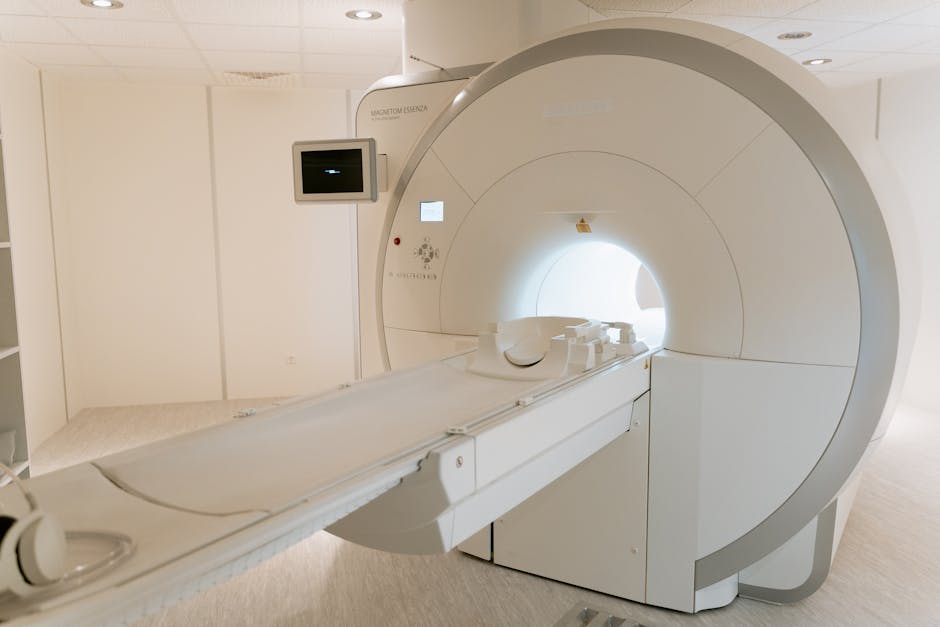
Last week, Midjourney announced what it's calling the "MJ-1"—a full-body ultrasound scanner that looks like a cross between an MRI tube and a high-end hot tub. You climb in, get submerged in water up to your neck, and the device produces a 3D volumetric scan of your entire body. The company's marketing materials describe it as "something as powerful as MRI" yet "as casual as a trip to the spa."
According to www.theverge.com, the announcement came with almost no peer-reviewed research, no clinical trial data, and very few details about how the technology actually works. The company showed off a few rendered images of the device and some sample scans that look... fine? But fine is not what you want from a medical diagnostic tool.
The hype-to-evidence ratio is off the charts
Here's the thing about medical imaging: it's really, really hard. MRI machines cost millions of dollars and require superconducting magnets cooled with liquid helium. CT scanners bombard you with ionizing radiation. Ultrasound is safer, but it's operator-dependent—a skilled sonographer can spot a gallstone from across the room, while a bad one can miss a tumor the size of a grapefruit.
Midjourney claims its water-based ultrasound system solves all of that. The idea is that by submerging you in water, the device can get a perfect acoustic coupling with your entire body surface, eliminating the need for a human to move a probe around. Then its AI reconstructs a full 3D volume from the raw ultrasound data.
Sounds plausible in theory. But according to www.theverge.com, the company hasn't released any technical specs on the number of transducers, the frequency range, the resolution, or—crucially—the validation studies. We're supposed to just trust that a startup known for making pretty pictures from text prompts can suddenly build FDA-cleared medical hardware.
I've been covering tech long enough to know that when a company says "trust us, we have the secret sauce," the sauce is usually just ketchup.
The spa marketing is a red flag
Let's talk about the "casual as a trip to the spa" framing for a second. Medical imaging is not supposed to be casual. When you go for an MRI, you sign consent forms. You answer questions about metal implants. You might get contrast dye injected into your veins. The technician watches you through a window and talks to you through an intercom. It's clinical. It's serious. And it should be.
Midjourney's promotional material shows a person floating peacefully in a warm pool of water, eyes closed, looking like they're at a wellness retreat. The device is called the "MJ-1 Sanctuary." It comes with ambient lighting and optional aromatherapy.
This bothers me more than it probably should. Because what happens when someone goes for a "spa-like" scan and the AI finds something concerning? Who tells them? How is that conversation handled? The company hasn't said. The press release mentions "AI-powered health insights" but doesn't specify if those insights are reviewed by a radiologist before being shared.
I'm not saying medical technology can't be comfortable. I'm saying that comfort should never be the priority when the stakes are this high.
What we actually know about the technology
Let's get into the weeds, because this is where things get interesting—and not in a good way.
Ultrasound works by sending high-frequency sound waves into the body and measuring the echoes that bounce back. Different tissues reflect sound differently, which is how you can distinguish a liver from a kidney from a cyst. But ultrasound has limitations. Bone blocks sound. Air in the lungs and gut creates artifacts. And the resolution drops off quickly with depth—you can see a fetus clearly at 20 weeks because it's shallow and surrounded by fluid, but imaging an adult's deep abdominal organs is much harder.
Midjourney's approach uses a phased array of transducers embedded in the walls of the water tank, firing from multiple angles simultaneously. The company says its AI can reconstruct a clean 3D image from all that noisy data. It's not a new idea—researchers have been working on "ultrasound tomography" for decades. But no one has made it work well enough to replace conventional ultrasound or MRI. Not even close.
I spoke with a radiologist friend of mine who asked to remain anonymous because he doesn't want to get dragged into internet drama. His reaction was blunt: "If it sounds too good to be true, it probably is. Water-based ultrasound has fundamental physics problems. The speed of sound in water is different from tissue, and you're introducing refraction artifacts at every interface. A neural network can't just wish those away."
He's right. AI is amazing at pattern recognition, but it can't violate the laws of physics. If the raw data is garbage, the AI output will be garbage—just prettier garbage.
The pivot makes no strategic sense
Midjourney raised a massive round of funding last year—rumored to be in the hundreds of millions—and has been looking for ways to expand beyond the increasingly crowded AI image generation market. But going from "text-to-image" to "medical body scanner" is like Apple suddenly deciding to manufacture cardiac pacemakers. It's not just a pivot. It's a leap across a chasm.
The company has zero experience in medical devices. Zero. No regulatory team. No clinical partnerships. No history of working with hospitals or insurance companies. Building a medical device from scratch typically takes 5-10 years and costs hundreds of millions of dollars in R&D, clinical trials, and regulatory submissions. Midjourney seems to think it can skip all that because it has good AI.
I've seen this before. Theranos. Juicero. A dozen other startups that thought they could reinvent a regulated industry with software and hype. It doesn't end well.
The regulatory hurdles are enormous
In the United States, any medical device that claims to diagnose disease must be cleared by the FDA. The process is rigorous, expensive, and slow. For a Class II device like an ultrasound scanner, you typically need to show "substantial equivalence" to an existing cleared device. That means running clinical studies, submitting reams of data, and waiting months or years for approval.
Midjourney hasn't said whether it's pursuing FDA clearance. The company's CEO gave a vague interview saying they're "working with regulators" and "aim to launch in select international markets first." Translation: they're going to try to sell it in countries with looser regulations, then use that as leverage to get into the US market.
It's a common playbook, and it's dangerous. Devices that aren't properly validated can miss cancers, give false positives that lead to unnecessary biopsies, or cause harm directly. A water-filled tank presents its own risks: infection control, electrical safety, patient dignity. None of these are trivial.
The comparison to MRI is dishonest
Let's address the elephant in the room: Midjourney's claim that this device is "as powerful as MRI." That's not just optimistic. It's false.
MRI works by aligning hydrogen atoms in a powerful magnetic field and then zapping them with radio waves. It produces images with exquisite soft-tissue contrast. You can see the layers of the brain, the cartilage in a joint, the internal structure of a tumor. Ultrasound cannot do that. No amount of water or AI will make it do that.
I understand why the company made the comparison. "Ultrasound" sounds boring. "Like MRI but cheaper and spa-like!" sounds exciting. But it's a lie by implication. The device might be able to do some things that MRI can do—like measure organ volumes or detect large cysts—but it will never match MRI's resolution or diagnostic power.
When you make a claim that extreme, you lose credibility. And in medical technology, credibility is everything.
What Midjourney should have done instead
Look, I'm not anti-innovation. I think AI has enormous potential in healthcare. There are companies doing genuinely impressive work using AI to analyze existing medical images—detecting breast cancer in mammograms, identifying diabetic retinopathy in retinal scans, flagging suspicious nodules in CT scans. That's the right approach: augment the tools we already have, not try to reinvent the entire imaging modality.
Midjourney could have been a leader in that space. It has world-class image generation capabilities. It could have built a platform that helps radiologists interpret scans faster and more accurately. It could have partnered with existing ultrasound manufacturers like GE or Philips to add AI-powered features to their devices.
Instead, it decided to build a bathtub with cameras and call it a medical miracle.
I hope I'm wrong. I hope the MJ-1 turns out to be a genuine breakthrough that makes diagnostic imaging accessible and affordable for everyone. I hope the physics works out, the AI is as good as promised, and the regulatory path is smoother than it looks.
But I've been burned too many times by tech companies promising to reinvent medicine. And this one smells exactly like the others.
The bottom line
Midjourney's pivot to medical body scanners is either a visionary leap or a catastrophic distraction. Based on the evidence available—and the lack thereof—I'm leaning heavily toward the latter. The company has shown us renders, not results. It has made claims that defy physics and regulatory reality. And it has framed a medical diagnostic tool as a consumer wellness product, which is exactly the kind of thinking that led to the Theranos disaster.
Will the MJ-1 ever actually ship to patients? Maybe. But if it does, I hope the regulators take a very, very close look before anyone gets into that water.
Because the last thing we need is another startup treating human health like a prompt you can just generate.
Originally reported by www.theverge.com. Rewritten with additional analysis and real-world context by Thomas Blackwell.