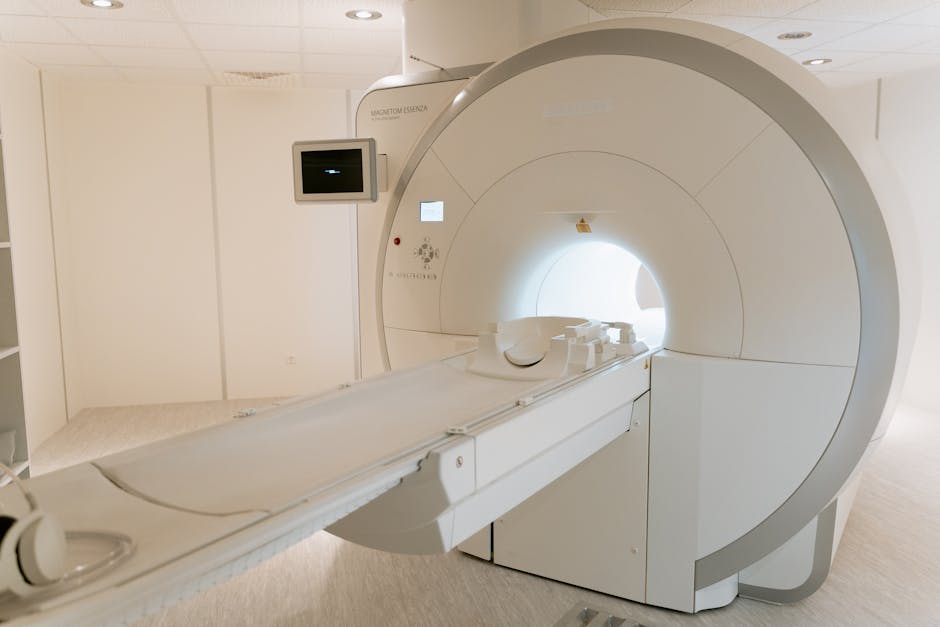
Last week, Midjourney—the company that taught millions of us how to generate surreal cat portraits and dystopian cityscapes—announced it was getting into medical imaging. Yes, medical imaging. The startup unveiled what it calls a "whole-body ultrasound scanner" that involves dunking a person into a vat of water. The goal, according to the company's press materials: produce "something as powerful as MRI" yet "as casual as a trip to the spa."
I read that sentence three times, and I still can't decide if it's brilliant marketing or a sign that we've collectively lost our minds.
Let's start with the obvious: Midjourney is not a medical company. It's an AI research lab that makes pretty pictures. Its image generator is genuinely impressive—I've used it to mock up UI concepts and generate reference art for friends who are illustrators. But there's a chasm between generating a photorealistic image of a cat wearing a top hat and diagnosing a liver tumor. That chasm is called "regulation," "peer review," and "basic clinical evidence."
According to www.theverge.com, the company's announcement was light on specifics. The scanner, which looks like a cross between an MRI machine and a hot tub, uses ultrasound transducers embedded in the walls of the water tank. The idea is that water provides better acoustic coupling than traditional gel, allowing for higher-resolution images. In theory, that makes sense. In practice, there's a reason why no one has commercialized a water-based ultrasound scanner at scale. It's not because no one thought of it. It's because it's really, really hard.
The Spaification of Medicine
Here's the thing: I love the idea of making medical imaging less intimidating. I've had an MRI. It's loud, claustrophobic, and feels like being slowly eaten by a giant robot. If you told me I could get the same diagnostic information by floating in a warm pool for 20 minutes, I'd sign up tomorrow. But that's a fantasy, not a product.
Midjourney's CEO, David Holz, framed the pivot as a natural extension of the company's work. "We've spent years building models that understand visual structure," he said in the announcement. "Medical imaging is just another domain where we can apply that understanding."
That's a nice soundbite. It's also dangerously reductive. Understanding the visual structure of a cat does not mean you understand the visual structure of a human pancreas. And even if you did, you'd still need to validate that your device can reliably detect pathologies. The FDA doesn't care how good your AI looks at generating images. It cares about sensitivity, specificity, and false-positive rates.
What the Announcement Actually Says
According to www.theverge.com, the company's press release was notably vague about clinical validation. It mentioned "early tests on phantoms"—those are synthetic objects that mimic human tissue—but didn't release any data. No peer-reviewed studies. No comparison to existing ultrasound systems. No mention of FDA clearance or even a timeline for seeking it.
This is a red flag the size of a banner ad. Medical device startups live and die by their regulatory strategy. If you don't have a plan for getting through the FDA, you don't have a product. You have a science fair project.
And let's talk about the "casual as a trip to the spa" angle. I get it. The company wants to make the scanner feel approachable. But here's the problem: when I go to a spa, I'm not expecting a diagnosis. I'm expecting a massage and some cucumber water. If the spa attendant tells me I have a suspicious mass in my kidney, that's not relaxing. That's terrifying. The casualness of the experience doesn't make the news any less devastating.
The Hype Cycle Trap
I've been covering tech long enough to recognize the pattern. A company with no medical experience announces a breakthrough device. The press goes wild. Investors pile on. Then, months or years later, the product either quietly disappears or gets revealed as vaporware. Remember Theranos? Remember the countless "AI that can diagnose anything" startups that fizzled out?
Midjourney is not Theranos—at least, not yet. The company has a track record of shipping actual products. Its image generator is real, it's popular, and it's genuinely useful. But that track record doesn't automatically translate to medical devices. Building a consumer AI product is hard. Building a medical device is a different order of magnitude of hard. You need clinical trials, manufacturing quality systems, post-market surveillance, and a team of doctors and engineers who understand human anatomy, not just neural networks.
Does Midjourney have that team? The announcement didn't say. It mentioned a partnership with a university medical center, but didn't name the institution. That's another red flag. If you have a real academic partner, you name them. Unless the partnership is still in the "we emailed a professor once" stage.
The Water Problem
Let's geek out on the technical side for a second. Water-coupled ultrasound is not new. Researchers have been playing with it for decades. The idea is that water has similar acoustic impedance to human tissue, which means less signal loss at the interface. In theory, you can get better image quality. In practice, you have to deal with a bunch of practical nightmares:
- Water temperature affects sound speed, which affects image reconstruction. You need precise temperature control.
- Bubbles form in the water, creating artifacts that look like pathologies.
- The patient has to be completely still. Floating in warm water makes you want to relax, not hold still.
- Hygiene. Oh god, the hygiene. You'd need to filter and sanitize the water between every patient. That's expensive and slow.
These are solvable problems. But they're not trivial. And Midjourney's announcement didn't address any of them. It just showed a concept video of a person floating serenely in a glowing tank while colorful images appeared on a screen. It looked beautiful. It also looked like a Kickstarter campaign for a product that will never ship.
What Would Convince Me?
I want to be wrong. I genuinely hope Midjourney pulls this off. A low-cost, non-invasive, spa-like imaging device could be a game-changer for preventive medicine. Imagine getting a full-body scan once a year as part of your annual physical, catching cancers early, and avoiding the anxiety of traditional imaging.
But wanting something to be true doesn't make it true. If Midjourney wants to be taken seriously, it needs to do three things:
-
Publish data. Show us the phantom images. Better yet, show us images from real patients, compared to traditional ultrasound and MRI. Let independent researchers evaluate them.
-
Name your academic partner. If you're working with a real medical center, say which one. Let their experts talk to the press.
-
Outline your regulatory path. Are you going for FDA 510(k) clearance? De novo classification? What's the timeline? If you don't have a regulatory plan, you don't have a product.
The Bigger Picture
Midjourney's pivot is part of a larger trend of AI companies trying to expand into high-stakes domains. We've seen AI startups claim they can diagnose depression from your voice, predict heart attacks from your retinal scans, and detect cancer from your selfies. Most of these claims don't hold up under scrutiny. The ones that do take years of validation and iteration.
What bothers me about Midjourney's announcement is the lack of humility. The company is acting like medical imaging is just another application of its technology, like generating a picture of a dragon. It's not. It's a field where mistakes can kill people. A false positive leads to unnecessary biopsies, anxiety, and cost. A false negative leads to missed diagnoses and delayed treatment. The stakes are not abstract.
I asked a radiologist friend what she thought of the announcement. She laughed. "I've been doing this for 20 years," she said. "If someone told me they could replace an MRI with a hot tub, I'd ask what they're smoking." She wasn't dismissing the idea entirely—she acknowledged that water-coupled ultrasound has theoretical advantages. But she emphasized that the devil is in the details. "Show me the images," she said. "Then we'll talk."
The Verdict (So Far)
Midjourney's body scanner feels like a fever dream. It's ambitious, futuristic, and almost certainly premature. The company has a track record of innovation, but innovation in one domain doesn't guarantee success in another. Medical devices require a different kind of rigor, a different timeline, and a different relationship with failure.
I'll be watching this space closely. If Midjourney delivers on its promise, I'll be the first to celebrate. But until I see real data, real regulatory filings, and real clinical validation, I'm going to treat this announcement like what it probably is: a flashy PR stunt designed to keep the company in the headlines.
And honestly? That's kind of sad. Midjourney's image generator is genuinely impressive. It doesn't need to invent a fake medical device to stay relevant. It just needs to keep doing what it does well. But I guess that's not how tech works anymore. Every company has to be everything, all at once, even if it means selling hot tubs as MRI machines.
What's Next?
I reached out to Midjourney for comment on the specifics of their regulatory strategy and clinical data. As of publication, I haven't heard back. I'll update this piece if they respond.
In the meantime, I have a question for you, the reader: would you get into a water tank for a medical scan? If it meant avoiding the claustrophobia of an MRI, would you trust an AI company to read the results? I'm genuinely curious. Drop me a line.
And if you're a radiologist reading this: what would it take for you to trust a water-based ultrasound system? I'd love to hear your perspective.
Because here's the thing: the future of medical imaging is going to look different from today. It might involve AI. It might involve water. It might involve things we haven't even imagined yet. But that future will only be worth having if it's built on evidence, not hype.
Midjourney's body scanner is a beautiful idea. Now it needs to become a real one.
Originally reported by www.theverge.com. Rewritten with additional analysis and real-world context by Jennifer O'Donnell.