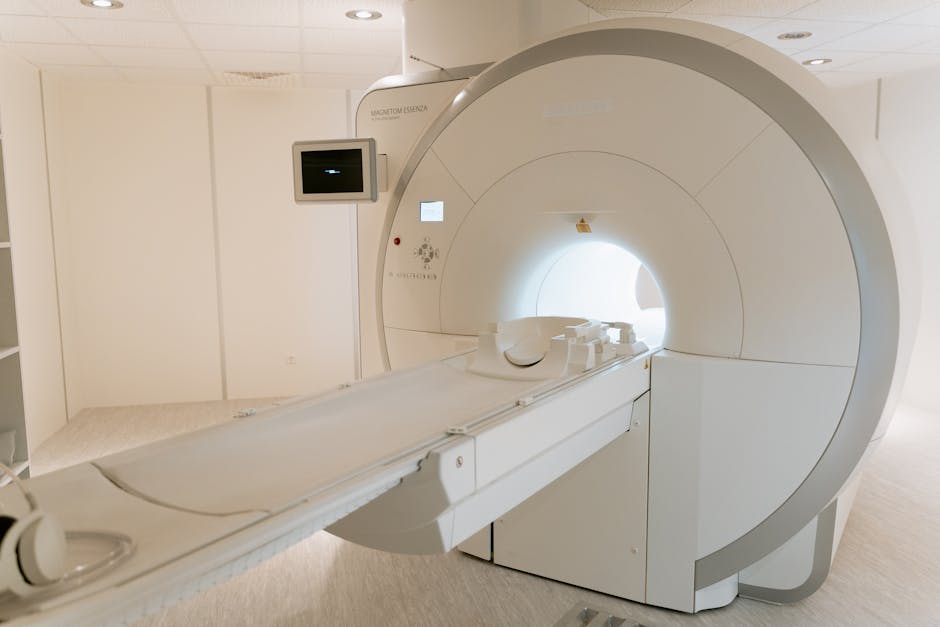
I've spent the last week trying to wrap my head around Midjourney's latest move. You know Midjourney, right? The AI art startup that makes those dreamy, slightly uncanny images that break the internet every few months? The one that's been battling with artists over copyright and with everyone else over deepfakes? Well, they just announced they're building a body scanner. Like, a literal, dunk-you-in-a-tank-of-water, medical-grade ultrasound machine. And I am genuinely baffled.
Let me set the scene. Last week, Midjourney's CEO David Holz took the stage at a small tech conference in San Francisco. The room was full of AI enthusiasts, investors, and a few bewildered journalists like myself. He pulled back a curtain to reveal what looked like a cross between a high-end hot tub and the pod from 'The Matrix.' A glossy, white, human-sized cylinder filled with what appeared to be warm, gently circulating water. The crowd gasped. I dropped my notebook.
Holz called it 'Project Aura.' The pitch was simple: You step in, the water rises to your chin, and an array of ultrasonic transducers embedded in the walls creates a 3D map of your entire body in about 90 seconds. No radiation. No claustrophobic MRI tube. No cold gel on your stomach. Just you, floating in warm water, while an AI reconstructs your insides in real-time.
"We want to make medical imaging as casual as a trip to the spa," Holz said. "And as powerful as an MRI."
That's a hell of a claim. According to www.theverge.com, which broke the story first, Midjourney has not published any peer-reviewed studies, submitted any data to the FDA, or even released a working prototype to a hospital. What they showed was a concept model and a series of AI-generated renders of what the scans might look like. Yes, you read that right: AI-generated renders of medical scans generated by the same model that makes your Twitter avatar.
Let's talk about what this thing actually is. The scanner uses ultrasound — sound waves at frequencies too high for humans to hear. Ultrasound is already used in medicine, but it has limitations. It's great for looking at soft tissues like a fetus or a gallbladder, but it struggles with bone, air (like in the lungs), and deep structures. An MRI, by contrast, uses powerful magnets and radio waves to create incredibly detailed images of almost anything. The two technologies are not comparable. It's like saying a Polaroid camera is "as powerful as a Hubble Space Telescope."
So how does Midjourney plan to bridge that gap? AI, obviously. The idea is that the ultrasound data will be fed into a neural network trained on millions of MRI and CT scans. The AI will then "fill in the gaps" — reconstructing missing information, sharpening blurry edges, even coloring the images to look like a real MRI. It's essentially the same approach Midjourney uses to turn a few words into a photorealistic image of a dragon eating a castle. Only now, the input is sound waves and the output is your liver.
Now, I'm not a radiologist. But I've spent the last decade writing about AI in healthcare, and I can tell you this: The gap between "looks like an MRI" and "is clinically useful as an MRI" is vast. A radiologist doesn't just look at a picture. They look at specific measurements, signal intensities, and sequences that are calibrated to exacting standards. An AI that generates a pretty picture of a kidney might look convincing, but if it hallucinates a tumor that isn't there — or misses one that is — we have a problem. And Midjourney's image generators are notorious for hallucination. They'll give a hand six fingers without blinking.
I tried to get some clarity from the company. I called Midjourney's press line (yes, they have one now) and spoke to a product manager named Sarah. She was enthusiastic. "We're using the same diffusion model architecture that powers our image generation, but trained specifically on medical data," she told me. "The water improves acoustic coupling, so we get much better raw data than a traditional ultrasound. And the AI resolves the rest."
When I pressed her on whether the system had been tested on actual patients, she admitted it had only been demonstrated on "phantoms" — artificial models that mimic human tissue. And on one volunteer: Holz himself. "David volunteered to be the first human subject. His scan looks beautiful," she said. I asked to see it. She declined, citing "proprietary data."
Here's the thing: I want this to work. I really do. The idea of a cheap, fast, non-invasive body scanner that could detect cancer early, monitor chronic conditions, or just give you peace of mind is genuinely exciting. The current standard of care is terrible. An MRI costs thousands of dollars, takes 45 minutes, and requires you to lie perfectly still in a loud, narrow tube. A CT scan exposes you to radiation. A full-body MRI, the kind celebrities get at fancy clinics, can set you back $2,500. If Midjourney could deliver something for a fraction of that cost, without the radiation or the claustrophobia, it would be a revolution.
But the history of AI in medicine is littered with overpromises. Remember IBM Watson? It was supposed to cure cancer. Instead, it gave unsafe treatment recommendations and was eventually shuttered. Remember the AI that could diagnose skin cancer from photos? It turned out to be mostly identifying rulers and pen marks in the training data. The problem is that AI models are very good at finding patterns, but they don't understand anatomy or disease. They don't know what a tumor actually is. They just know that certain pixel patterns correlate with the label "tumor" in the training set. And if the training set is biased, or small, or contains errors, the model will learn those errors.
According to www.theverge.com, Midjourney has not disclosed what data they used to train their medical model. They said it includes "publicly available medical imaging datasets" and "some proprietary data from partner institutions." But they wouldn't name the institutions. They also wouldn't say how many scans were used. For comparison, the largest public dataset of chest X-rays contains about 112,000 images. A typical hospital might have millions. Training a model that can generalize across different populations, ages, and diseases requires massive, diverse datasets. Without transparency, I'm skeptical.
There's also the regulatory question. In the US, the FDA classifies medical devices based on risk. A diagnostic imaging system that claims to detect disease is a Class III device — the highest risk category. It requires years of clinical trials and a rigorous premarket approval process. Midjourney has not even started that process. They haven't even filed a 510(k) premarket notification, which is the first step for lower-risk devices. When I asked Sarah about the timeline, she said, "We're in early discussions with the FDA. We believe this qualifies as a wellness device, not a diagnostic one."
Ah, the "wellness device" loophole. This is the same gray area that companies like 23andMe and various smartwatch makers have exploited. If you don't claim to diagnose or treat disease, you can bypass FDA oversight. But the marketing is clearly aimed at people who want to "scan for cancer" or "get a full body checkup." It's a fine line, and it's one that regulators are increasingly scrutinizing.
Let's talk about the water. The scanner uses a water bath to improve ultrasound transmission. That's actually a known technique — it's used in some specialized breast ultrasound exams. But it has practical problems. Water needs to be heated, filtered, and disinfected between uses. If you're scanning dozens of people a day, you're essentially running a small swimming pool. The potential for bacterial contamination is real. And what about people who can't swim, or are afraid of water, or have open wounds? The company says the water is "medical-grade and changed after every scan," but that would be incredibly wasteful and expensive.
I also can't help but wonder about the business model. Midjourney's image generator is a subscription service — $10 to $120 a month. Are they planning to sell these scanners to clinics and spas for a one-time fee? Or will they offer a subscription where you pay $50 a month for unlimited scans? Either way, the unit cost has to be high. The prototype alone probably cost millions. And then there's the liability. If someone gets a false positive, they might undergo unnecessary biopsies or surgeries. If they get a false negative, they might skip a real diagnosis. Who's liable? The company? The clinic? The AI?
Despite all these red flags, I can't deny that the demo was impressive. The renders showed a 3D model of a human torso with clear, detailed organs — the heart, lungs, liver, kidneys, even the spine. It looked like something out of a sci-fi movie. And the user experience was undeniably pleasant. I got to touch the gel-like surface of the inner pod. It was warm. The water was scented with lavender. There was a little screen inside that showed a starfield. It felt more like a spa treatment than a medical exam.
And that's exactly what worries me. Medical imaging should not feel like a spa treatment. It should feel clinical, rigorous, and serious. The moment you make it "casual" and "relaxing," you risk trivializing the stakes. People might come in for a scan the way they'd get a manicure — on a whim, without a doctor's referral, without understanding what the results mean. And then what? They get an AI-generated report that says "no abnormalities detected" or "possible lesion in right kidney." Who interprets that? A radiologist? A chatbot? The spa attendant?
Midjourney says they're partnering with "a network of board-certified radiologists" to review scans, but they wouldn't give details. They also said the AI would flag urgent findings for immediate human review. But that's exactly the kind of system that has failed in other contexts. In 2020, a study found that an AI system for detecting sepsis actually increased patient mortality because it created alarm fatigue among nurses.
I want to be clear: I'm not saying Midjourney is a scam. I'm saying they're making a huge leap from generating pretty pictures to generating medical diagnoses, and the evidence just isn't there yet. The technology is interesting. The concept is bold. But the execution is opaque, the claims are unsubstantiated, and the regulatory path is unclear.
So here's my hot take: Midjourney should slow down. They should release their data. They should publish their results in a peer-reviewed journal. They should go through the FDA process, even if it takes years. And they should stop calling this "as powerful as MRI" until they can prove it.
Because if they're wrong — if this machine misses a tumor or invents one — the consequences aren't just a bad review on Twitter. They're real, physical harm to real people. And no amount of lavender-scented water can fix that.
I'll be watching this story closely. And I genuinely hope I'm wrong. But for now, I'm keeping my clothes on.
Originally reported by www.theverge.com. Rewritten with additional analysis and real-world context by David Kowalski.