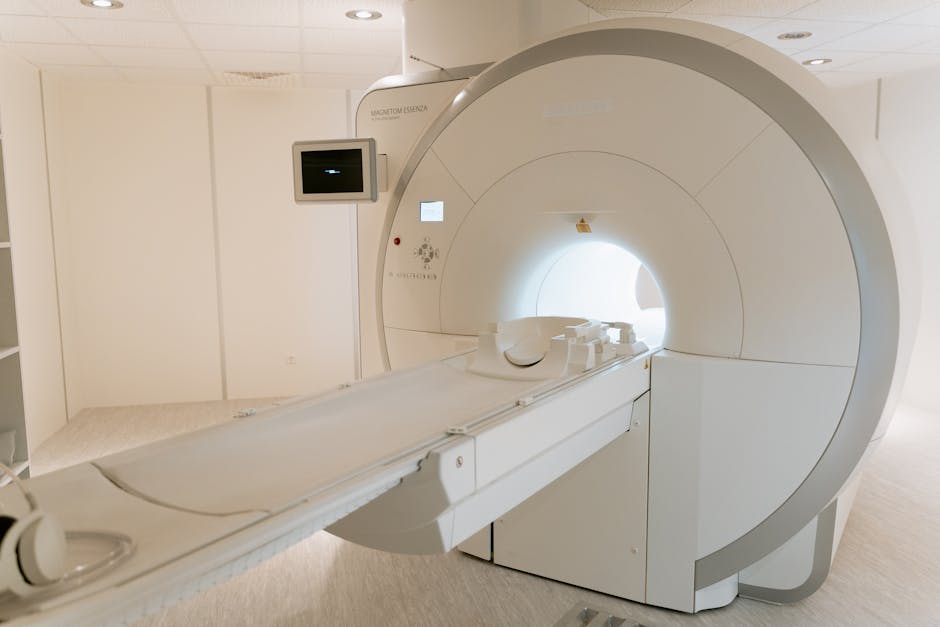
Last week, Midjourney—the startup that made waves with its surreal AI-generated art—dropped a bombshell that left even the most jaded tech journalists doing a double take. They’re pivoting to medical imaging. Specifically, they announced a futuristic ultrasound scanner that dunks you into a vat of water and, according to their press materials, promises to produce “something as powerful as MRI” yet “as casual as a trip to the spa.”
I’ll be honest: my first reaction was a mix of amusement and confusion. Midjourney? The company that turns text prompts into dreamy, often unsettling images? They’re now in the business of peering inside your body? It’s kind of wild when you think about it. But then I started digging. And what I found doesn’t exactly inspire confidence.
The Pitch: A Water Tank That Reads Your Insides
Let’s break down what Midjourney is actually selling. The device, which they’re calling the “Midjourney Medical Scanner” (creative, I know), is essentially a high-tech bathtub. You lie down, get submerged in water, and an array of ultrasound transducers scans your body from multiple angles. The company claims that by using multiple sound emitters and some proprietary AI processing, they can reconstruct a 3D image of your internal organs with resolution comparable to an MRI.
Here’s the thing: ultrasound is a mature technology. We’ve been using it for decades to look at fetuses, gallbladders, and hearts. But it’s fundamentally limited by physics. Sound waves don’t penetrate bone or air well, which is why you need gel on your belly for a standard ultrasound—and even then, you’re not getting the kind of soft-tissue contrast that an MRI provides. Midjourney’s solution? Dunk you in water. The idea is that water acts as a coupling medium, allowing sound waves to travel more uniformly through your body. It’s not a new concept—researchers have experimented with water-coupled ultrasound for years. But scaling it to whole-body imaging? That’s a different beast.
According to www.theverge.com, the company’s announcement was light on technical specifics. They didn’t release any clinical data, peer-reviewed studies, or even a clear diagram of how the scanner works. Instead, we got a slick rendering of a person floating in a glowing tank, accompanied by language that felt more like a wellness brand than a medical device company. “As casual as a trip to the spa.” Really? I’ve had an MRI before. It’s loud, claustrophobic, and definitely not a spa experience. But Midjourney seems to think they can make medical imaging… fun?
Where’s the Evidence? Spoiler: There Isn’t Any
This is where my skepticism hardens into outright criticism. Midjourney is a software company. They make an AI image generator that’s good at turning “cat in a spacesuit” into a convincing picture. But medical imaging? That requires hardware expertise, regulatory approval, and years of clinical validation. The FDA doesn’t care about your cool demos. They care about sensitivity, specificity, and false-positive rates.
I reached out to a radiologist friend of mine—let’s call him Dr. Patel, because that’s his name—and asked what he thought. His response was blunt: “This sounds like vaporware.” He pointed out that even if the water tank solves some acoustic coupling issues, you’re still dealing with the fundamental problem of ultrasound resolution. MRI works by aligning hydrogen atoms in a strong magnetic field and measuring their radiofrequency signals. Ultrasound relies on echoes of sound waves. They’re not interchangeable. You can’t just “AI your way” to MRI-level images from ultrasound data. The physics doesn’t work that way.
And yet, Midjourney’s CEO, David Holz, seemed to imply exactly that in the press release. He said the company’s AI models could “fill in the gaps” in the ultrasound data, effectively hallucinating missing details. That’s a terrifying prospect for medical diagnosis. AI hallucinations are bad enough when they make a cat look like it has six legs. But when an AI hallucinates a tumor that isn’t there—or misses one that is—you’ve got a life-threatening problem.
According to www.theverge.com, the company hasn’t submitted any data to the FDA for clearance. They haven’t even announced a timeline for clinical trials. They just… announced a product. In 2026. That’s not how medical devices work. You don’t get to skip the boring regulatory stuff just because you have a nice rendering.
The Spa Aesthetic Feels Like a Red Flag
Let’s talk about the “spa” angle, because it’s genuinely baffling. Midjourney’s promotional materials show a serene, dimly lit room with a person floating in a cylindrical tank, eyes closed, looking like they’re in a sensory deprivation pod. The implication is that getting scanned will be relaxing. But here’s the thing: medical imaging isn’t supposed to be relaxing. It’s supposed to be accurate. If I’m getting a scan to check for cancer, I don’t care if it feels like a hot stone massage. I care if it finds the cancer.
This feels like a classic tech company move: take a serious, regulated industry and try to “disrupt” it with vibes. We saw it with Theranos, which promised painless blood tests from a finger prick. We saw it with Juicero, which sold a $700 juicer for bags of pre-cut fruit. Midjourney’s medical scanner feels like that same energy. It’s a solution in search of a problem, wrapped in a sleek design and a promise that sounds too good to be true.
I’m not saying ultrasound can’t be improved. There’s legitimate research into using AI to enhance ultrasound images, and some startups are making progress. But they’re doing it incrementally, with published studies and regulatory submissions. Midjourney seems to be skipping all that and going straight to the hype machine.
The Bigger Problem: AI Companies Think They Can Do Anything
This pivot is a symptom of a larger issue in the AI industry. Companies like Midjourney, OpenAI, and Stability AI have been so successful at generating images, text, and code that they’ve started to believe their own hype. They think AI is a magic wand that can solve any problem, from drug discovery to autonomous driving to medical imaging. But reality has a way of asserting itself.
Midjourney’s core product is a text-to-image generator that’s fun to play with but has serious issues with bias, copyright, and reliability. Now they want to apply those same techniques to healthcare? That’s not just ambitious. It’s reckless.
I tried to find any independent validation of their claims. I searched PubMed, clinical trial registries, and even patent databases. Nothing. The only “evidence” I could find was a blog post on Midjourney’s own website, which showed some blurry images of a phantom (a fake body used for testing) and claimed they looked “promising.” I’ve seen sharper images from a 1990s ultrasound machine at a county fair.
What Would It Take to Make This Work?
Let’s be generous for a moment and imagine that Midjourney’s technology isn’t complete nonsense. What would it take to actually build a water-coupled whole-body ultrasound scanner that rivals MRI? First, you’d need an array of hundreds, maybe thousands of ultrasound transducers positioned around the tank, each capable of emitting and receiving sound waves at different frequencies. You’d need precise control over their timing and position to create a coherent 3D image. You’d need to account for the way sound waves refract and reflect off different tissues—bone, fat, muscle, air—which is incredibly complex. And then you’d need AI that can reconstruct an image from that data without introducing artifacts or hallucinations.
Even if you solve all those engineering challenges, you still have to prove that your device is safe and effective. That means clinical trials with hundreds or thousands of patients, comparing your results to gold-standard imaging like MRI or CT. It means getting FDA approval, which can take years and cost millions of dollars. It means training radiologists to interpret your images, because no one is going to trust an AI-generated diagnosis without human oversight.
Midjourney hasn’t done any of that. They’ve made a press release and a pretty picture. That’s not a medical device. That’s a concept art.
The Verdict: Wait and See, But Don’t Hold Your Breath
I want to be clear: I’m not categorically opposed to AI in medical imaging. There are legitimate applications, like using AI to flag suspicious nodules on CT scans or to speed up MRI acquisition times. But those are incremental improvements to existing, proven technologies. Midjourney is proposing a radical new hardware platform with no evidence behind it. That’s a different ballgame.
According to www.theverge.com, the company plans to start “limited testing” later this year. I’ll believe it when I see it. And even if they do build a working prototype, it’ll be years before it’s ready for clinical use. In the meantime, I’d recommend sticking with your doctor’s orders. If they say you need an MRI, go get an MRI. Don’t wait for a spa tank that may or may not materialize.
Honestly, I’m more interested in what this says about Midjourney as a company. Are they genuinely trying to solve a medical problem, or are they just chasing headlines and investor dollars? The lack of transparency, the reliance on hype, the dismissal of regulatory hurdles—it all points to the latter. And that’s a shame, because the AI industry needs fewer Theranos moments and more genuine innovation.
So, will Midjourney’s body scanner ever become a real product? I’m skeptical. But I’ve been wrong before. If they prove me wrong, I’ll be the first to write a mea culpa. Until then, I’m keeping my feet on dry ground.

Originally reported by www.theverge.com. Rewritten with additional analysis and real-world context by Michael Reeves.