The Training Pipeline: From Data to Model
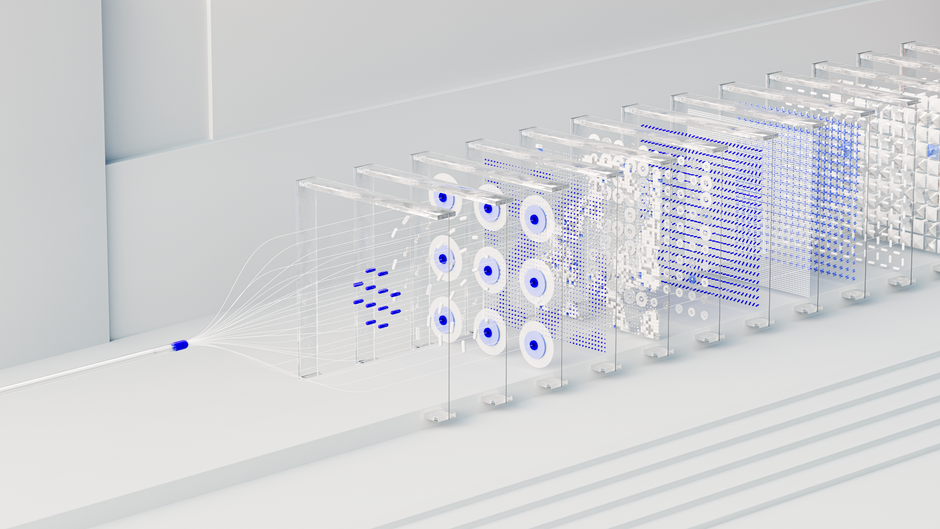
Training an AI model is fundamentally a process of learning from examples. The journey from raw data to a trained, deployable model follows a structured pipeline with several distinct stages. Understanding this pipeline is essential for anyone who wants to grasp how modern AI systems actually work and why they have the strengths and weaknesses they do.
The first and most critical stage is data collection. The quality, quantity, and representativeness of the training data determine the upper bound of the model's performance. No amount of clever algorithm design can compensate for poor data. If you train a model on data that is biased, incomplete, or unrepresentative of the real world, the model will reflect those flaws. For a large language model, this means gathering billions of words from diverse sources — books, articles, websites, code repositories, and academic papers. For a computer vision model, it means collecting millions of labeled images spanning the full range of conditions the model will encounter in deployment.
Data preprocessing is the next stage. Raw data is rarely ready for training. Text data may contain formatting artifacts, HTML tags, duplicate passages, or personally identifiable information that must be removed. Image data may need resizing, normalization, and color correction. Numerical data may have missing values, outliers, and inconsistent scales. Data scientists typically spend 60 to 80 percent of their time on data preparation, not on building models. The preprocessing pipeline also includes splitting the data into training, validation, and test sets — separate portions used for learning, tuning, and final evaluation respectively.
Once the data is prepared, the actual training process begins. This is an iterative cycle where the model makes predictions, compares them to correct answers, calculates errors, and updates its internal parameters to reduce those errors. Each complete pass through the entire training dataset is called an epoch. Training typically continues for multiple epochs — often dozens or hundreds — until the model's performance stops improving or begins to degrade on the validation data.
But does it actually work that way?
The Training Loop in Detail
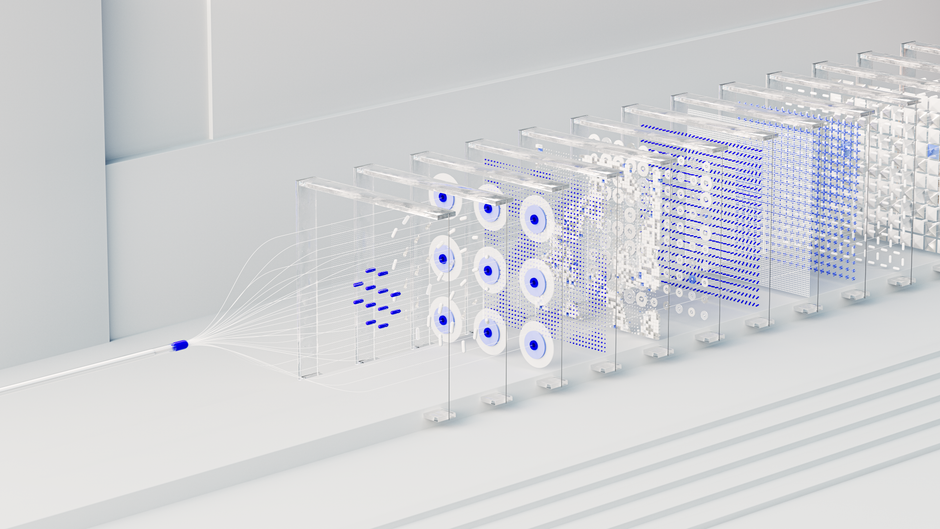
Inside the training loop, a specific sequence of operations repeats thousands or millions of times. First, a batch of training examples is fed into the model. The batch size is an important hyperparameter — too small and training is noisy and inefficient; too large and it requires more memory than available. Each example in the batch passes through the model's layers, undergoing a forward pass that transforms the input data into a prediction.
The model's prediction is compared to the correct answer using a loss function. The loss function quantifies how wrong the prediction is — a high loss means the model is far from the correct answer, a low loss means it's close. Different tasks use different loss functions. For classification tasks, cross-entropy loss is common. For regression tasks, mean squared error is typical. For language models, the loss measures how well the model predicts the next token in the sequence.
With the loss calculated, the model performs backpropagation. This is the algorithm that makes deep learning possible. Backpropagation works backward through the model's layers, calculating the contribution of each parameter to the total loss using the chain rule from calculus. The result is a gradient for every parameter, indicating the direction and magnitude of adjustment needed to reduce the loss.
After testing this extensively, finally, an optimization algorithm uses the gradients to update the model's parameters. Gradient descent is the fundamental optimization algorithm, but modern training uses sophisticated variants like Adam or SGD with momentum. These optimizers adjust the learning rate during training, helping the model converge faster and avoid getting stuck in poor solutions. The updated model then processes the next batch, and the cycle repeats.
Hyperparameters: The Settings That Control Training
It works.
I was skeptical at first, but hyperparameters are configuration settings that control the training process itself, as opposed to the model parameters that are learned during training. Choosing the right hyperparameters is part art and part science, and it can dramatically affect the final model's performance. The most important hyperparameters include the learning rate, batch size, number of epochs, and model architecture choices.
The learning rate controls how large each parameter update is during training. If the learning rate is too high, the model's parameters may overshoot the optimal values, causing training to diverge or oscillate without converging. If the learning rate is too low, training will be excruciatingly slow and may get stuck in suboptimal solutions. Modern training often uses learning rate schedules that start high and gradually decrease, or adaptive methods that adjust the learning rate per parameter.
Batch size affects both training speed and model quality. Larger batch sizes provide more accurate gradient estimates and better utilize GPU parallelism, making training faster. However, very large batch sizes can lead to sharper, less generalizable minima — the model converges to solutions that work well on the training data but fail to generalize to new data. Smaller batch sizes introduce more noise into the gradient estimates, which can actually help the model escape poor local minima and find flatter, more generalizable solutions.
My take: regularization hyperparameters help prevent overfitting — the phenomenon where a model memorizes the training data instead of learning generalizable patterns. Weight decay adds a penalty for large parameter values, encouraging the model to use simpler representations. Dropout randomly removes a fraction of neurons during each training step, forcing the network to develop redundant representations. Early stopping halts training when validation performance stops improving, preventing the model from over-specializing to the training data.
Pre-Training and Fine-Tuning
The modern AI development paradigm separates training into two distinct phases: pre-training and fine-tuning. Pre-training is the massive, expensive, one-time process of training a foundation model on a vast, general-purpose dataset. The result is a model with broad capabilities — it understands language, knows facts about the world, can reason about common situations, and has a general grasp of many domains.
Fine-tuning adapts a pre-trained model for a specific task or behavior. This requires far less data and compute than pre-training — typically a few thousand to a few hundred thousand examples rather than billions. Fine-tuning can specialize a general language model to write legal documents, answer medical questions, or adopt a specific personality. It can adapt a general computer vision model to detect specific manufacturing defects or identify particular plant species.
The efficiency of fine-tuning relies on transfer learning — the knowledge the model acquired during pre-training transfers to the new task. The pre-trained model already understands language structure, general concepts, and reasoning patterns. Fine-tuning simply adjusts its existing knowledge toward the target domain. This is why organizations can build useful custom AI systems without the multi-million-dollar budgets required for pre-training.
In addition to full fine-tuning, there are parameter-efficient techniques like LoRA (Low-Rank Adaptation) that achieve comparable results by training only a small number of additional parameters while keeping the pre-trained weights frozen. These approaches make fine-tuning accessible to organizations with limited computational resources and enable rapid experimentation with different tasks and behaviors.
Computational Requirements and Scaling Laws
Here's why.
Training modern AI models requires enormous computational resources. The largest models use thousands of specialized AI processors — GPUs or TPUs — running continuously for weeks or months. A single training run for a frontier model like GPT-4 costs tens of millions of dollars in computing resources alone, not including data acquisition, engineering salaries, or research costs.
The field has identified empirical scaling laws that describe how model performance improves with increased compute, data, and parameters. In general, larger models trained on more data with more compute perform predictably better. However, there are diminishing returns and practical limits. Training a model twice as large requires roughly twice the compute but does not produce twice the capability improvement. This has led to intense debate about whether continued scaling is the best path forward, or whether algorithmic improvements and better data will yield more efficient progress.
The environmental impact of training large AI models is significant. A single large training run can consume as much electricity as hundreds of households use in a year, with corresponding carbon emissions. However, the efficiency of inference — using the trained model — is much better. A model trained once can serve millions of users with relatively modest per-query energy consumption. The AI community is actively working on more efficient architectures, training methods, and hardware to reduce the environmental footprint.
For a deeper understanding of how training shapes model behavior, read our article on AI hallucinations and learn about how machine learning works.
What Actually Matters
Honestly, - AI model training follows a pipeline: data collection, preprocessing, iterative training loop, and evaluation
- The training loop consists of forward pass, loss calculation, backpropagation, and parameter update — wish I'd known this six months ago
- Hyperparameters like learning rate, batch size, and regularization settings critically affect training outcomes
- Pre-training builds a general-purpose foundation model; fine-tuning adapts it for specific tasks
- Transfer learning makes fine-tuning efficient, requiring far less data and compute than pre-training
- Training requires enormous computational resources — large models cost millions of dollars and weeks or months to train — your experience may differ, but this worked for me
- Scaling laws describe how performance improves with more compute, data, and parameters, but algorithmic improvements offer an alternative path forward (this one actually surprised me)